
Putting the AI-Driven Sell-Off in Perspective
November 19, 2026 | John Lohse
Today’s blog was written by Chris Fasciano, Chief Portfolio Strategist, LPL Financial.
Market volatility has intensified over the past week as concerns have grown about the outlook for AI spending, the implications for global economic growth, and the potential impact on S&P 500 earnings expectations in 2026 and 2027.
It’s normal for investors to become concerned during periods of market volatility. They question their long-term objectives and whether they have more risk in their portfolios than they can tolerate. Those feelings are often amplified when markets react quickly to new information and uncertainty.
As Ben Graham famously observed, “In the short run, the market is a voting machine, but in the long run, it is a weighing machine.” Over the last month, investors have clearly voted that the positive fundamentals that helped markets overcome inflation, tariffs, geopolitical tensions, and other headline risks may now be at risk themselves. However, history has illustrated that times like this can create opportunities for long-term investors where appropriate.
What Has Changed in the AI Outlook?
Two major issues have impacted AI exposed stocks over the last month. The first occurred on Election Day, when Democrats won a majority in the Senate, the House, and key governorships across the country. Several of these changes in leadership at the state level occurred in areas where AI data center buildouts have been prevalent, such as Texas, Georgia, and Ohio. This led some investors to worry that projects could face delays or higher costs due to increased regulatory scrutiny.
Even if these concerns were to come to fruition, it is unlikely to change 2027 spending plans but could begin to have an impact in 2028.
The second event occurred when Nvidia’s (NVDA) CEO, Jensen Huang, resigned from the company. Not only has he been the leading advocate for the AI sector, under his leadership Nvidia has provided financing for customers and data center buildouts alike. Interim CEO Collette Kress indicated that Nvidia intends to be more selective regarding future investments and financing commitments. While the company remains committed to supporting strategic partners, investors interpreted the comments as a sign that financing conditions for some AI-related projects could become less favorable going forward. This too raises concerns about a slowdown in the AI buildout.
Regardless of the ultimate outcome, the recent selloff serves as a reminder that even fundamentally driven bull markets experience periods of uncertainty and correction.
Market Declines Are Not Unusual Even In the Best Years
Sell-offs never feel good, and emotions run high during periods of turmoil. But the magnitude of this correction and the speed at which it happened weren’t unprecedented.
A Historically Normal Drawdown
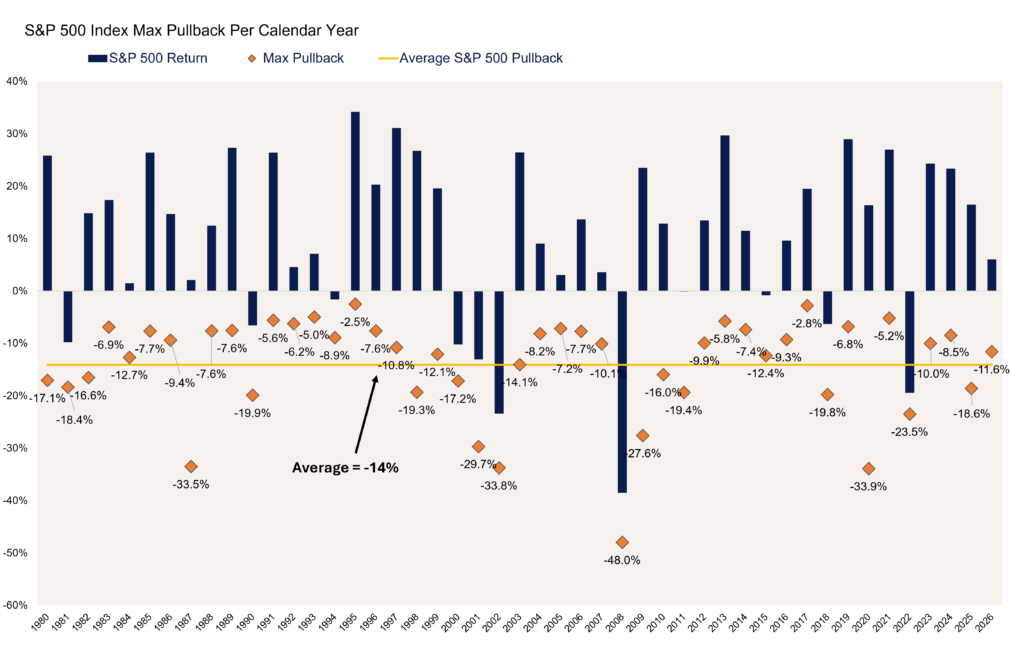
Source: LPL Research, FactSet 11/19/26
Disclosures: All indexes are unmanaged and cannot be invested in directly. Past performance is no guarantee of future results.
The “A Historically Normal Drawdown” chart illustrates that over the last 46 years, the average S&P 500 drawdown in a year is 14%. Despite that occurrence, 35 of those years have ended with the index closing higher.
While every sell-off has its own catalyst, they often share a common theme: investors begin to question whether new developments could alter the outlook for economic growth and corporate earnings. Market participants have seen that happen several times over the last couple of years whether the catalyst was inflation, tariffs, war in the Middle East, or AI spending.
Don’t Miss the Forest for the Trees
There is no doubt that AI companies are an important driver of recent market returns. Companies such as Microsoft (MSFT), Meta Platforms (META), Alphabet (GOOG/L), and Nvidia (NVDA) have had strong fundamentals and exceptional earnings growth. Investors have rightfully rewarded those companies. The S&P 500 has become top heavy with a significant weighting in the 10 biggest names. This has led to a market cap-weighted decline of over 11% from the all-time high set in early October.
But the index is made up of another 490 names. The equal weighted S&P 500, which removes the impact of the size of the company from the index weighting, has declined roughly 2% over the same period. The market isn’t repricing the entire economy. It’s repricing expectations around a relatively small number of AI-dependent stocks
While the largest AI-related companies have driven a significant share of recent market returns, their size has also magnified the impact of the recent pullback on capitalization-weighted indices. Investors with diversified allocations across sectors and styles may find that portfolio performance has been more resilient than headline index moves suggest.
History suggests that periods of uncertainty often feel most uncomfortable precisely when investors are being presented with compelling long-term opportunities. While no one can predict how the current AI debate will ultimately unfold, maintaining a diversified portfolio aligned with long-term objectives has historically been one of the most effective ways to navigate short-term volatility while remaining positioned for future growth.
Important Disclosures
This material is for general information only and is not intended to provide specific advice or recommendations for any individual. There is no assurance that the views or strategies discussed are suitable for all investors. To determine which investment(s) may be appropriate for you, please consult your financial professional prior to investing.
Investing involves risks including possible loss of principal. No investment strategy or risk management technique can guarantee return or eliminate risk.
Indexes are unmanaged and cannot be invested into directly. Index performance is not indicative of the performance of any investment and does not reflect fees, expenses, or sales charges. All performance referenced is historical and is no guarantee of future results.
This material was prepared by LPL Financial, LLC. All information is believed to be from reliable sources; however LPL Financial makes no representation as to its completeness or accuracy.
Unless otherwise stated LPL Financial and the third party persons and firms mentioned are not affiliates of each other and make no representation with respect to each other. Any company names noted herein are for educational purposes only and not an indication of trading intent or a solicitation of their products or services.
Asset Class Disclosures –
International investing involves special risks such as currency fluctuation and political instability and may not be suitable for all investors. These risks are often heightened for investments in emerging markets.
Bonds are subject to market and interest rate risk if sold prior to maturity.
Municipal bonds are subject and market and interest rate risk and potentially capital gains tax if sold prior to maturity. Interest income may be subject to the alternative minimum tax. Municipal bonds are federally tax-free but other state and local taxes may apply.
Preferred stock dividends are paid at the discretion of the issuing company. Preferred stocks are subject to interest rate and credit risk. They may be subject to a call features.
Alternative investments may not be suitable for all investors and involve special risks such as leveraging the investment, potential adverse market forces, regulatory changes and potentially illiquidity. The strategies employed in the management of alternative investments may accelerate the velocity of potential losses.
Mortgage backed securities are subject to credit, default, prepayment, extension, market and interest rate risk.
High yield/junk bonds (grade BB or below) are below investment grade securities, and are subject to higher interest rate, credit, and liquidity risks than those graded BBB and above. They generally should be part of a diversified portfolio for sophisticated investors.
Precious metal investing involves greater fluctuation and potential for losses.
The fast price swings of commodities will result in significant volatility in an investor’s holdings.
This research material has been prepared by LPL Financial LLC.
Not Insured by FDIC/NCUA or Any Other Government Agency | Not Bank/Credit Union Deposits or Obligations | Not Bank/Credit Union Guaranteed | May Lose Value
For Public Use – Tracking: #1213306