
Municipal Bonds at Midyear: Let the Coupon Do the Work
Lawrence Gillum | Chief Fixed Income Strategist
Last Updated: August 18, 2026
The Setup: A Market Built for Patience
The municipal bond market enters the second half of 2026 in a familiar but underappreciated position: digesting record levels of new issuance while continuing to benefit from resilient investor demand and a Federal Reserve (Fed) that appears likely to remain on hold. That backdrop may not generate eye-catching price appreciation, but it doesn’t need to. With tax-equivalent yields for investment-grade municipals still in the top quartile of their 10-year history, this remains a market where income, rather than capital gains, is expected to drive returns. For investors who have spent the past several years waiting for a more attractive entry point, the second half of 2026 serves as an important reminder: in fixed income, the entry point is often the yield, and today’s yields remain compelling.
The Fed’s most recent meeting reinforced that perspective. Policymakers kept the federal funds rate unchanged at 3.50% to 3.75% for a fifth consecutive meeting. While the 9–3 vote highlighted some concerns, with three committee members dissenting in favor of a rate hike, recent inflation trends have generally moved in a more favorable direction. As a result, we believe the hurdle for additional rate increases remains high. Although market volatility could persist ahead of the Fed’s next meeting on September 16, any further backup in yields should be viewed as a buying opportunity rather than a cause for concern.
Against this backdrop, municipal market valuations remain attractive. After years of inversion, the AAA municipal yield curve has re-steepened considerably, offering nearly 200 basis points between one-year and 30-year maturities. Importantly, investors can capture much of the available tax-exempt yield in the intermediate portion of the curve, roughly five to 20 years, without taking on the greater duration risk associated with long-dated bonds. July’s sell-off was a useful reminder of how quickly that long-end volatility can emerge.
The steeper curve also improves the return potential from roll-down, an increasingly valuable source of performance in a rangebound rate environment. As intermediate-maturity bonds age and move down the yield curve, their yields typically decline and prices appreciate, providing an additional source of return on top of the coupon income. In a market where large directional moves in rates appear less likely, that combination of attractive income, favorable carry, and roll-down potential remains one of the most compelling opportunities available in fixed income today.
AAA Muni Curve Remains Steep Versus History
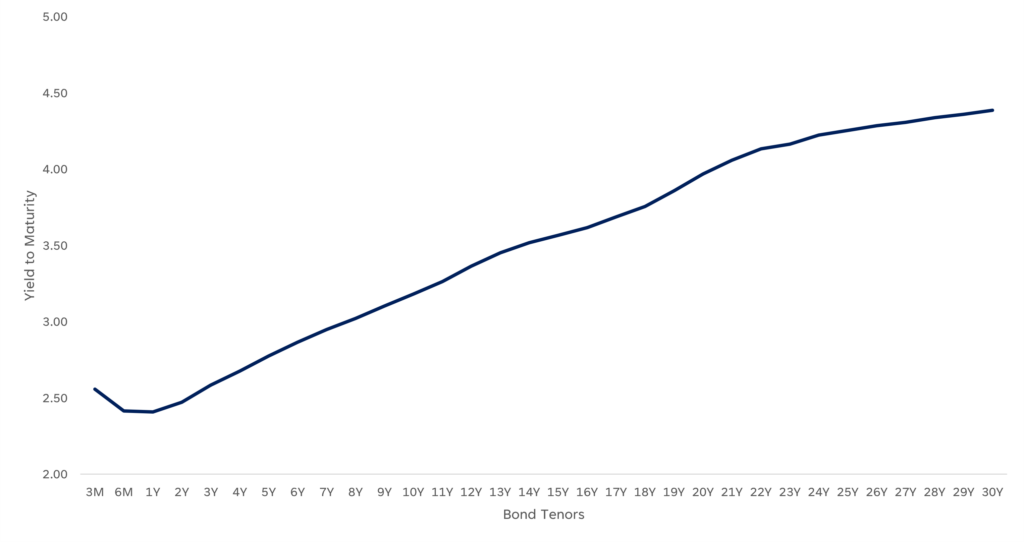
Source: LPL Research, Bloomberg 08/17/26
Disclosures: Past performance is no guarantee of future results.
What Does This Mean for Investors?
The second half of 2026 favors the patient. A Fed on-hold anchors the front end and makes cash progressively less compelling. Record gross supply is being offset by still strong reinvestment demand. A historically steep curve makes the intermediate range the sweet spot, delivering most of the available yield plus roll-down return without long-end volatility. The golden age of fiscally supercharged municipal credit is likely behind us, downgrades are picking up, and widening dispersion is exactly the environment where active management and disciplined security selection should outperform (no guarantees of course). Stay up in quality, favor the intermediate part of the curve, and let historically elevated tax-equivalent yields do what they were designed to do: compound.
Important Disclosures
This material is for general information only and is not intended to provide specific advice or recommendations for any individual. There is no assurance that the views or strategies discussed are suitable for all investors. To determine which investment(s) may be appropriate for you, please consult your financial professional prior to investing.
Investing involves risks including possible loss of principal. No investment strategy or risk management technique can guarantee return or eliminate risk.
Indexes are unmanaged and cannot be invested into directly. Index performance is not indicative of the performance of any investment and does not reflect fees, expenses, or sales charges. All performance referenced is historical and is no guarantee of future results.
This material was prepared by LPL Financial, LLC. All information is believed to be from reliable sources; however LPL Financial makes no representation as to its completeness or accuracy.
Unless otherwise stated LPL Financial and the third party persons and firms mentioned are not affiliates of each other and make no representation with respect to each other. Any company names noted herein are for educational purposes only and not an indication of trading intent or a solicitation of their products or services.
Asset Class Disclosures –
International investing involves special risks such as currency fluctuation and political instability and may not be suitable for all investors. These risks are often heightened for investments in emerging markets.
Bonds are subject to market and interest rate risk if sold prior to maturity.
Municipal bonds are subject and market and interest rate risk and potentially capital gains tax if sold prior to maturity. Interest income may be subject to the alternative minimum tax. Municipal bonds are federally tax-free but other state and local taxes may apply.
Preferred stock dividends are paid at the discretion of the issuing company. Preferred stocks are subject to interest rate and credit risk. They may be subject to a call features.
Alternative investments may not be suitable for all investors and involve special risks such as leveraging the investment, potential adverse market forces, regulatory changes and potentially illiquidity. The strategies employed in the management of alternative investments may accelerate the velocity of potential losses.
Mortgage backed securities are subject to credit, default, prepayment, extension, market and interest rate risk.
High yield/junk bonds (grade BB or below) are below investment grade securities, and are subject to higher interest rate, credit, and liquidity risks than those graded BBB and above. They generally should be part of a diversified portfolio for sophisticated investors.
Precious metal investing involves greater fluctuation and potential for losses.
The fast price swings of commodities will result in significant volatility in an investor’s holdings.
This research material has been prepared by LPL Financial LLC.
Not Insured by FDIC/NCUA or Any Other Government Agency | Not Bank/Credit Union Deposits or Obligations | Not Bank/Credit Union Guaranteed | May Lose Value
For Public Use – Tracking: #1160868